THE BOOK SERIES OF THE WESTERN PRELACY OF THE ARMENIAN APOSTOLIC CHURCH OF AMERICA
FUNDAMENTALS AND PHASES IN THE MAKING OF THE WESTERN ARMENIAN WORLD
ՀԻՄՆԱՀԱՐՑԵՐ ԵՒ ՀԱՆԳՐՈՒԱՆՆԵՐ ԱՐԵՒՄՏԵԱՆ ՀԱՅԱՇԽԱՐՀԻ ԿԱԶՄԱՒՈՐՈՒՄԻՆ ՄԷՋ
as
HISTORIOGRAPHY, META-HISTORIOGRAPHY AND
SOUL-SEARCHING
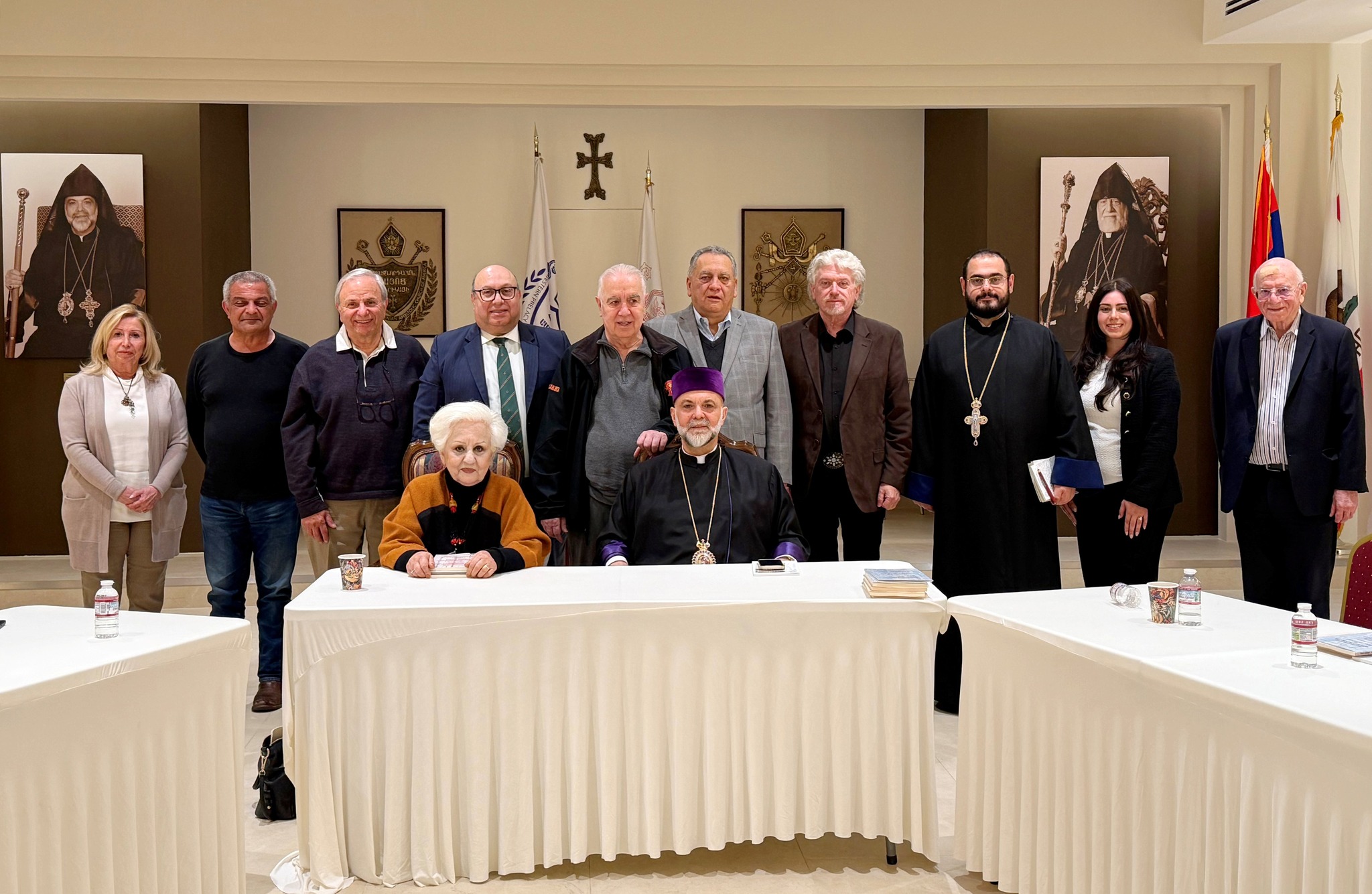
Probably the first in its kind, the Book Series of the Western Prelacy ‒ Fundamentals and Phases in the Making of the Western Armenian World ‒ was the subject of a ‘Round Table’ in Armenian, on February 25 at the Prelacy, under the title Historiography, Meta-Historiography and Soul-Searching. This is also the title of the talk by Professor Seta B. Dadoyan, the author of the Series, published in a booklet for the occasion. The author explains the new approaches and the objectives of the Series, with an emphasis on the formation and evolution of the Western Armenian World, and the political history of the Armenian Church and its men. The booklet has the title pages of the three books of the Series and the Table of Contents of each. So far two volumes are published in 2025, the third is in press:
Nersēs IV Shnorhali – Saint and Diplomat and the Persistence of the People and the Church in the Western Armenian World/Ներսէս Դ. Շնորհալի Սուրբ եւ Դիւանագէտ եւ Ժողովուրդին ու Եկեղեցիին Գոյատեւումը Արեւմտեան Հայաշխարհին մէջ. (2025).
Yovhan III Ōdznets‘i Saint, Jurist and Great Master of Armenian Mesopolitan Culture and Diplomacy/ Յովհան Գ. Օձնեցի (իշխ.717-728) Սուրբը, Կանոնագէտը և Մեծ Վարպետը Հայ Միջնաշխարհեան Մշակոյթի եւ Դիւանագիտութեան. (2025)
Prolegomenon to the Millennial History of the Western Armenian World ‒ The First Phase Tenth to Fifteenth Centuries – From Kingdoms to Awakening, Politics and Culture. (2026)
Prempted by a lecture on Nerses IV Shnorhali (Nov. 22, ’24, on the occasion of the 850th anniversary of his death) the Book Series has its genesis in social, cutural as well as historiographic concerns. One of its main objectives is to make the lived historical experiences and the itellectual culture ‒ not the imagined, created or planned narratives ‒ accessible and existentially meaningful and relevant to the public.
Both in medieval, modern and recent mainstream Armenian histories ‒ but not historiographic works ‒ there are many moot areas, gaps and impasses. The causes are to be sought in the perspectives and methodology of the historians and flaws in their understanding of the Armenian historical experience in the Near Eastern World.
One of the most novel themes of the Series is the political history of the Armenian Church of over seventeen centuries. It has always been marginally and circumstantatially referred to. The social-political career and legacy of major figures, like Ōdznets’i, Narekats’i and Shnorhali ‒ themes in the Series ‒ also their full personalities are practically eclipsed. They are many others who remain ‘faliliar strangers.’ Thus, Shnorahali is known for his spiritual sogs (sharakans) and theology, Narekats’i for his healing powers of his Narek.
The study of Shnorhali in the context of his tumulteous times of interneal and external conflicts and Narekatsi as an ingenious revolutionary, a social and ideological dissident of the tenth century are overdue tasks. The Series analyzes and suggests perspectives along these lines for a deeper and more accurate understanding of the Armenian historical evolution.
The methodology and the approach of the author are interdisciplinary. This implies and requires bringing together politics, sociology, culture, arts, and most importantly the critical-philosophical method. There are not several Shnorhalis, a saint, a diplomat, a theologian or a poet. There is only one Shnorhali who is all these simultaneously. Therefore, focusing on one narrow aspect has inevitably impoverished not only the figure but his circumstances and role.
One of the radical historiographic novelties of the Book Series is a shift in paradigms. The author suggests the paradigm of two historic Armenian worlds: an Eastern one in the east around the mainland, and a Western, much bigger and more dynamic Armenian World in its west and south. Already from the late tenth century, after the fall of the Armenian dynastic territories by 1045, and the massive migrations of the people to the west and south, a vast Armenian habitat/ecumene developed into a Western Armenian World. These two worlds developed differently, each in its region.
This is a radically new way of looking at the Armenian condition. The paradigm of a Center-Periphery, the ‘center’ being the mainland, and the ‘periphery’ the so-called Diaspora, is not based on historical facts. However, it even developed into the more recent dualism of Hayrenik‘-Fatherland and Sp‘iwṛk‘-Diaspora, a legacy of the Cold War. The historical record and experiences on the ground do not support this perspective. The situation in the Western Armenian World was very different from the East and surely much more complicated. They were simply different worlds. There was not and has never been a center and a periphery. That paradigm has no grounds in facts. Simply, there are two Armenian Worlds and one nation.
The situation inevitably developed complications, such as internal division, polarization, and certainly complications between the two worlds. The differences were unavoidable and expected in the inherently mesopolitan condition of the Armenians. Furthermore, it is often forgotten that from the middle of the seventh century, with the exception of Armenian Cilicia from the eleventh to the fourteenth centuries, most Armenians were under Islamic rules of several ethnicities. The religious head represented the dhimmī (non-Muslim subjects) communities before the Muslim state. Hence the political status and role of the Church and the clergy. Often agreements and pacts were signed with the catholicoi. The historiographic study of the Armenians in the Islamic World is in a primitive state. The author’s six volumes and many articles practically inaugurated this discipline in Armenian and Near Eastern studies.
The Armenian Intermezzo in the Near Eastern World is one of the major theories of the author. It is the interval of two centuries from the tenth century to the end of the twelfth, or the weakening then fall of the Armenian kingdoms, to the rise of another power in Cilicia in 1198/9. Despite the common opinion about its being a chaotic period, this Intermezzo was a period of unprecedented proliferation of political energy among Armenians of all classes and backgrounds, from the Black Sea to Cappadocia, Cilicia, Upper Mesopotamia, Al-Shām, Palestine and Egypt. Unfortunately, this most intriguing period in Armenian history has shrunk into the semi-heroic narrative of Cilicia.
As the author explains, Cilicia is not only an aspect of the Intermezzo but an immediate result. It is not a divine gift or a heroic episode, but a truly mesopolitan phenomenon, the first and longest lasting Armenian body politic in the history of the Western Armenian World, between the Muslim East and the Christian West.
During the two centuries of the Armenian Intermezzo, the realpolitik of various Armenian leaders, trends and factions of mixed backgrounds generated large and small enclaves in the Western Armenian World, such as Cilicia, the Georgian-Armenian Danishmandids in Cappadocia, the federal state of Philaretus from Gemanica to Antioch, the principalities of Melitene and Edessa, the Awakī-Nāwikīs in Palestine, the Jamālīs in Fāțimid Egypt and many lesser entities.
Cilicia, to which large sections are devoted in the Prolegomenon, the third book of the Series, was one of these phenomena on regional and international stages. It was surrounded and challenged by Byzantine Greeks, Seljuk Turks, Latin Crusaders, Sunni Ayyūbīs, then Mongols and Mamluks. It marked the beginning of the Western Armenian World on foreign land/s. The book traces the metamorphosis and the growth of the nation with all its political and religious institutions West and south of the native land, and its extraordinary persistence. Today, thousands of miles away, we are still walking on the same path. Hence the existential link between history and our condition here and now, also wherever and whenever.
The author of the Series also presents another hypothesis about Armenian sovereignty in the later Middle Ages. It is often referred to as the Armenian Age of Kingdoms, from the ninth to the eleventh centuries, as the only one. As a consequence of the Armenian Intermezzo there is a second Age, which she calls The Dynastic Triangle or the Second Age of Kingdoms. These are Cilicia, the City State of Erznka/Erzinjān, and the Georgian-Armenian Zakarians at Ani.
The analysis of the relationship between the Eastern and Western Armenian Worlds is the subject of fresh, critical objective studies. That task remains pending. The author discusses some of the reasons in the third volume.
Developing in very different environments and circumstances, the two worlds were bound to be divergent. The disagreements were inevitable, sometimes violent but always understandable. However, this is not public opinion. The book has a special section dedicated to a different and novel perspective on the ‘1441 Movement’, or the proclamation of the See of Ējmiatsin, while Grigor IX Musabekiants‘, the catholicos of All Armenians resided at Sis, in Cilicia.
The Armenians in the Western Armenian World were in truly mesopolitan condition. Their culture was very different from the east. Already in the eleventh century while the people, the feudal aristocracy and the Catholicosate were searching for minimal security and a land of their own, they were in contact with most factions and powers in different manners. Consequently, the Western side developed a more liberal and pragmatis culture, at least to survive. It was this peculiarity that contributed to the development of the Silver Age in the twelfth century, which led to a proto-awakening in the next two centuries in the entire Western Armenian World. Practically, single copy of the Matean Oghbergut‘ean was smuggled to Cilicia and reached Shnorhali. By order of Nersēs Lambronats‘i and the art of Grigor Skewṛatsi, it became the most luxurious single copy through which Narekats‘i was rescued from oblivion. It was in Cilicia that his humanism and new theology were understood and adopted.
The Series stops at the fifteenth century. The next periods are very different subjects.
Historiography, Meta-Historiography, Soul-Searching
Anyone who sees these books would consider them medieval history books or medieval literature (մատենագրութիւն). A librarian will index them accordingly. The classification is wrong and unfortunate. It is true that strictly historiographic methods are kept and applied, but the texts are not ‘history texts’, as commonly understood. These books are philosophies of history, historiographies, and going beyond it, meta-historiographies for collective soul-searching.
What is Historiography? Rather than dealing with just the events themselves, historiography is the critical study of how history is written, focusing on the methods, interpretations, and biases historians use when analyzing the past. It is therefore re-writing history based on fresh and critical examination of the sources, the selection of relevant episodes and details from the primary materials and the synthesis of those details into a novel account.
The new accounts created – such as the Western Armenian World, the political history of the Church ‒ not only should stand the test of critical examination but reveal the relevance of historical knowledge to the present conditions. By modernizing/updating the past, historiography makes it existentially relevant to the individual and community. Thus, the Book Series is trying to bring out the relevance of Shnorhali and Yovhan III to present circumstances.
When historiography seeks to bring out the existential dimensions of history it becomes what the author calls Meta-Historiography. This is an activity that goes beyond critical discipline, into a form of individual and collective soul-searching.
Soul searching is a deep and genuine introspection and assessment that goes beyond the level of just facts. It explores at the core who one is, where they come from and where they go/must go. One of the ways of soul-searching is writing down one’s experiences, in this case writing, rather, re-writing our historical experiences, actions and reactions. This means being mindful and analytical and above all, honest enough to admit errors and brave enough to change.